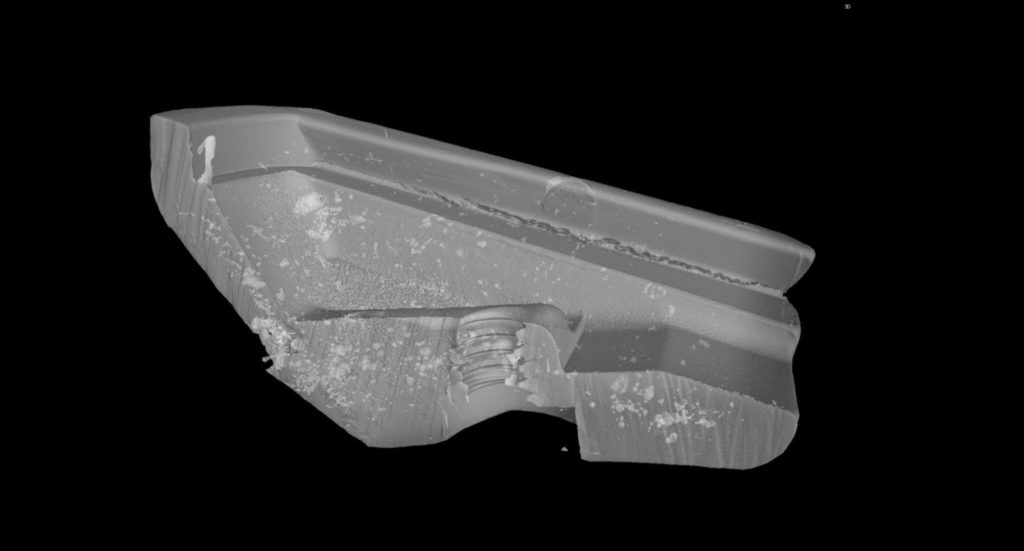
Using Industrial CT Scanning to Find & Prevent Casting Defects
Casting defects are a common issue in metal component manufacturing. If your component leaves the factory with tiny porous holes in it, you’re bound to receive negative feedback from customers. Proper quality control measures can help prevent this. By utilizing industrial CT scanning, you can improve your casting inspection process with accurate and unbiased data, regardless of which stage of manufacturing you’re in. CT scanning will help you find and prevent further casting defects.
Industrial CT scanners can test a wide range of castings made from a variety of materials, including die cast, forgings, sand cast, and castings made from metals like aluminum, brass, steel, and titanium.
Stages of Casting Quality Control Using CT Scanning
- Pre-Production – This is a vital step to saving you time and money in the long run. Internally inspecting your product with a CT scanner will allow you to reduce risk, ensure accuracy, decrease time to market, and give you the peace of mind that you’re going into production with a repeatable process that creates the highest quality parts.
- Production & Inspection – When failure is not an option, CT scanning is the way to go because production parts can be inspected at the highest standards of quality.
- Failure & Defect Inspection – Nondestructive testing methods like industrial CT scanning can identify internal part defects like gas porosity, shrinkage, and other defects that can be missed by the human eye.
Common Casting Defects in Metal Component Manufacturing>
- Casting defect gas porosities or pinholes – Gas porosity can happen when gas gets trapped in the metal during the casting process. If the solid metal form can’t hold as much gas as the liquid, bubbles will appear, taking on the shape of tiny pinholes or cavities in the metal.
- Shrinkage – Shrinkage can occur during the solidification process because metals are less dense as a liquid than as a solid.
- Issues or defects with the mold or casting – Defects can occur when the metal is poured into the mold or when there is something wrong with the actual mold/casting.
Benefits of Industrial CT Scanning
A nondestructive testing method, CT scanning gives us a look inside an object, generates precisely accurate internal dimensions, and generates extremely high-resolution imaging. Any object can be scanned, no matter the shape or size, and there is no post-processing work required. Additional benefits of using industrial CT scanning for nondestructive product testing include:
- Highly accurate measurements (+/-.010mm)
- Development and inspection costs reduced
- Product quality is improved, reducing the risk of recalls
- Pre-production inspection is reduced for complex parts
- Quick turnaround times allow for faster production
- No shaded zones
- Compatible with all shapes & sizes
- No post-processing rework necessary
Identify & Remedy Casting Defects Faster
Industrial CT scanning gives you a clear view inside your parts so you can catch defects early, before they become costly production problems. With decades of cross-industry experience, our team can help you pinpoint the root cause and determine the right fix, saving you time and money when it matters most.
Partner with Diverse Dimensions for Industrial CT Scanning
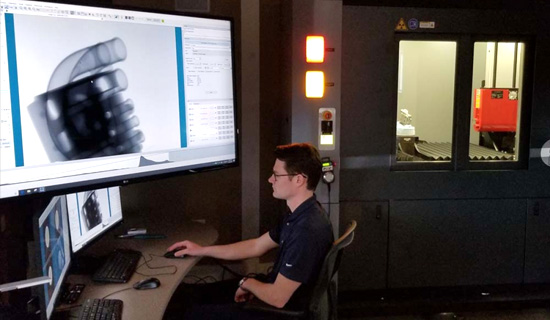
If you’re experiencing casting defects or you want to make sure there is no potential issue, reach out to our expert metrologist to learn more about the CT scanning process and how it can benefit your production process. At Diverse Dimensions, we use an RX Solutions EasyTom Nano High Resolution CT system. This is a state-of-the-art, highly flexible X-ray CT scan system with six linear motorized axes, allowing for optimized magnification for a variety of sample types and scanning configurations.
